 Veteran Owned & Operated

October 21, 2026 · AmpiFire Content
6 Dump Trailer Lift Types: Differences, Pros & Cons
Key Takeaways
-
Dump trailer lifts split into two groups: fixed-body hoists (telescopic, scissor, single or dual cylinder) and roll-off systems (cable or hooklift) built for removable containers.
-
Telescopic cylinders extend in stages for a long stroke from a compact assembly, while scissor hoists use hinged arms that fold open beneath the bed.
-
Single-cylinder hoists push with one ram near the centerline; dual-cylinder hoists use two rams that must stay synchronized to avoid uneven frame stress.
-
Hoist name alone never confirms lifting capacity or dump angle; those depend on the manufacturer's rated specs and frame engineering for that specific trailer.
-
Poplar Bluff Trailer offers telescopic, scissor, and cable roll-off dump trailers, with online financing and rent-to-own options, plus free in-store pickup and paid delivery to most of the Midwest.
Why Lift Type Matters on a Dump Trailer
Lift type determines how a dump trailer empties its load, how much stress the frame absorbs each cycle, and, for roll-off trailers, whether the hoist is a cable system built to load containers rather than tip a fixed bed. Most buyers shop by axle count, GVWR, or bed length first, then treat the hoist as an afterthought. That approach skips over the part of the trailer that fails most often under heavy, repeated use.
The real complication is that hoist names don't come with fixed specifications. Two trailers both labeled "dual cylinder" can carry very different tonnage depending on how the frame, cylinder mounts, and hydraulic system were engineered together. A buyer who only compares labels, rather than rated capacity and duty cycle, can end up with a hoist that is mismatched to the job before the trailer ever leaves the lot.
Poplar Bluff Trailer's lineup offers these hoist types side by side, letting shoppers compare telescopic, scissor, and direct-push configurations against the actual loads they plan to haul rather than guessing from a spec sheet.

Main Dump Trailer Lift Types
1. Telescopic Cylinder Hoist
A telescopic cylinder hoist uses a multi-stage hydraulic cylinder that extends in sections to raise the dump body in a direct-push design. The word "telescopic" describes how the cylinder itself is built, not how many cylinders are used or what dump angle the trailer reaches. That distinction matters because two telescopic hoists can perform very differently depending on their staging and mounting geometry.

Many telescopic hoists use hydraulic pressure to raise the bed and the bed's own weight to lower it, so check whether a unit is power up and gravity down.
Pros
-
Direct-push arrangement can provide strong lifting leverage, depending on cylinder sizing and mounting geometry.
-
Multi-stage extension delivers a long stroke from a relatively compact cylinder assembly.
-
Can suit heavy or dense loads when the trailer, hoist, and frame are all designed together for that work.
Cons
-
Multiple cylinder stages and seals add components that may need inspection and specialist service over time.
-
Performance varies with cylinder geometry, mounting points, bed length, and load placement.
2. Scissor Hoist
A scissor hoist pairs a hydraulic cylinder with hinged arms arranged in a folding linkage beneath the dump body. As the linkage opens, it drives the bed upward. This is one of the most common configurations for general-purpose dumping.
Pros
-
Linkage design provides a compact way to convert cylinder movement into bed lift.
-
Multiple attachment points can distribute lifting forces through the structure when properly engineered.
-
Works as a common, general-purpose configuration across many dump trailer models.
Cons
-
Linkage adds pivots and moving parts compared with a direct-push cylinder arrangement.
-
Takes up space beneath the bed, and its changing geometry affects lifting leverage throughout the dump cycle.
-
Wear, service needs, and performance still depend on the specific design and duty cycle.

Scissor hoist sizes vary by model, from the 5x16 hoist on MAXX-D's DKB8314 to the heavier 6x20 unit on its DJB8314H.
3. Single-Cylinder Direct-Push Hoist
A single-cylinder direct-push hoist uses one hydraulic ram, usually positioned near the trailer's centerline, to push the front of the dump body upward. That single cylinder may itself be a telescopic type, which is why this category often overlaps with telescopic hoists rather than standing apart from them.
Pros
-
One-cylinder layout means fewer cylinders, seals, and hydraulic connections than a comparable two-cylinder arrangement.
-
Simpler component layout can be an advantage where the rated capacity and duty cycle fit the application.
Cons
-
Lifting load concentrates at the single cylinder's mounting structure, which puts more weight on how well the frame and body were engineered to handle that force.
-
A single cylinder isn't automatically lower in capacity or durability than a dual-cylinder setup, since the cylinder's rating, mounting geometry, and surrounding structure decide that.
4. Dual-Cylinder Direct-Push Hoist
A dual-cylinder direct-push hoist uses two cylinders, typically placed on either side of the trailer's centerline, to lift the body. Unlike a single-cylinder setup, both rams have to work in coordination to produce a smooth, even lifting motion rather than a lopsided one.
This configuration shows up most often on trailers built for larger beds or heavier-rated loads, where distributing lift force across two points fits the frame design better than concentrating it in one location.
Pros
-
Two lift points can distribute force to separate areas of the body or subframe in a design built for that arrangement.
-
May suit applications where the manufacturer has specifically engineered and rated the twin-cylinder configuration for the intended loads.
Cons
-
Two cylinders and their hydraulic components increase part count compared with a single-cylinder layout, which can mean more potential failure points over the trailer's life.
-
Differences in cylinder movement or resistance can affect synchronization and place uneven forces on the structure, depending on the hydraulic system's design and how the frame was built to handle it.
5. Cable Roll-Off Hoist
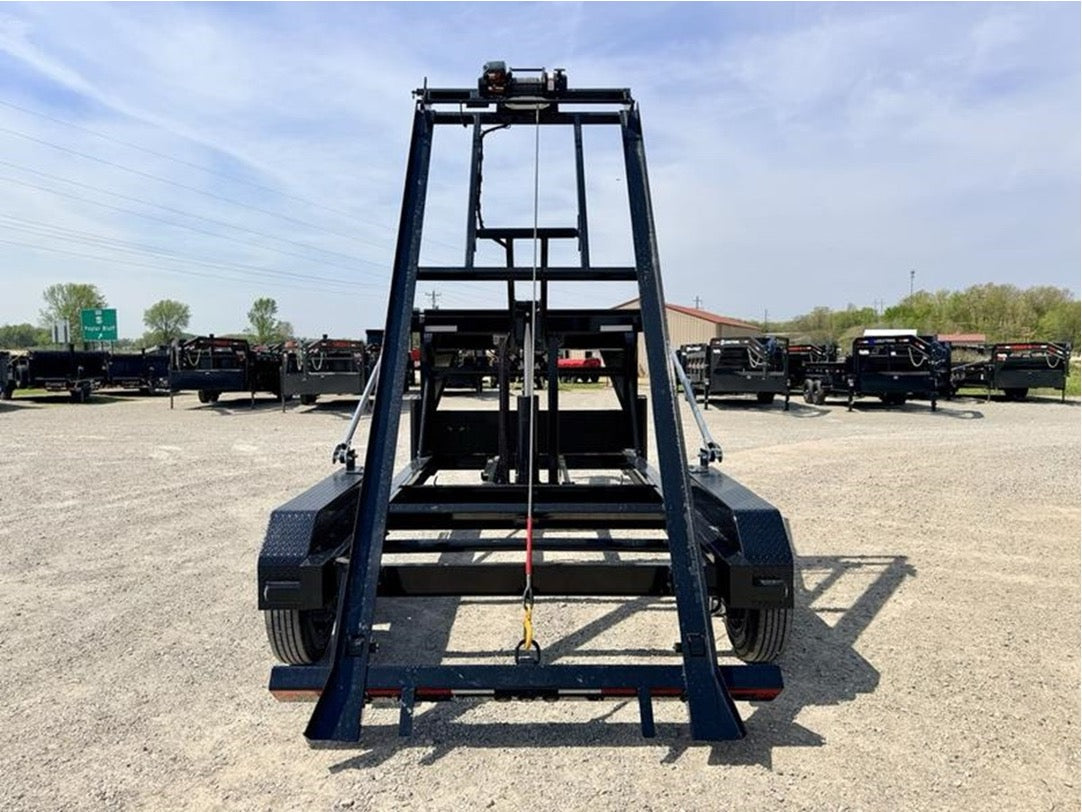
A cable roll-off hoist uses a winch and cable system to pull a container onto the trailer or lower it back down to the ground. Rails or rollers typically guide the container's movement during this process, keeping it aligned as it slides on or off the bed. Cable roll-off systems are widely used across the industry specifically because they accommodate a range of compatible container styles, making them a flexible option for operations that swap containers frequently.
This type of hoist is less about dumping material directly and more about moving entire containers. That makes it a different tool for a different job compared to the fixed-body hoists already covered.
Operations that rely on container exchange, where a trailer drops off a loaded container and immediately picks up an empty one at another site, benefit most from this setup. The trailer itself does not need to tip to perform its primary function.

Some cable roll-off trailers can also tilt a loaded container to dump material on site, so the bin doesn't always have to come off the trailer.
Pros
-
Supports container exchange workflows, letting a trailer drop off a loaded or empty container and move on to another task without waiting.
-
Cable systems are widely used in roll-off applications and can accommodate a variety of compatible container styles.
Cons
-
The operator has to connect and manage the cable as part of every loading and unloading cycle, adding a manual step that fixed-body hoists do not require.
-
Compatibility among the trailer, cable equipment, and container has to be confirmed, since systems can differ in their container and rail requirements.
6. Hooklift
A hooklift uses a hydraulic hook arm to engage a compatible container, then lifts and positions it onto or off the trailer. Instead of a winch pulling the container along rails, the hook arm does the physical work of lifting and swinging the container into place, which generally makes the connection point more direct than a cable system.
Pros
-
Hook mechanism can make container engagement and positioning more direct on compatible systems.
-
Allows one trailer to serve different jobs simply by changing out compatible bodies or containers.
Cons
-
A hooklift system only works with containers built to matching hook points and dimensions, so compatibility is non-negotiable.
-
The trailer, hook mechanism, and container all have to be matched as one system, since the hooklift label by itself does not tell you anything about capacity or fit.
Differences Between Dump Trailer Lift Types
|
Lift type |
How it works |
Main advantage |
Main trade-off |
|
Telescopic cylinder |
Multi-stage ram pushes up fixed dump body |
Long stroke in a compact assembly |
Cylinder stages and seals require attention |
|
Scissor hoist |
Cylinder opens hinged linkage under bed |
Linkage-based lift geometry |
More pivots and moving components |
|
Single-cylinder direct-push |
One ram raises the body |
Fewer cylinders and connections |
Capacity depends on geometry and frame design |
|
Dual-cylinder direct-push |
Two rams raise the body |
Two lifting points |
Coordination and added components |
|
Winch and cable move removable bins |
Efficient bin exchange |
Requires compatible bins and cable handling |
|
|
Hooklift |
Hydraulic hook loads/unloads bins |
Direct container engagement |
Requires compatible hook containers |
Match a Dump Trailer Lift to the Job with Poplar Bluff Trailer
The right lift type depends on what you haul, how often you dump, and the trailer's full rated capacity. Telescopic, scissor, and direct-push cylinders handle fixed-body dumping, while cable roll-off and hooklift systems serve crews that swap containers between sites.
We carry telescopic-cylinder dump trailers from brands like MAXX-D, Load Trail, Diamond C, and Texas Pride; scissor-hoist models from MAXX-D; and MAXX-D cable roll-off units for container work. Each listing names the lift type, so you can compare hoist setups across current units. Browse our dump trailers to find your fit.
Frequently Asked Questions (FAQs)
What is the difference between a scissor hoist and a telescopic hoist?
A scissor hoist uses hinged arms that fold open beneath the dump body, while a telescopic hoist uses a multi-stage hydraulic cylinder that extends in sections. Telescopic cylinders can also be used inside direct-push designs, so the two types sometimes overlap instead of staying fully separate.
Can a dump trailer have two hydraulic cylinders instead of one?
Yes, dual-cylinder direct-push hoists use two cylinders, usually placed on either side of the centerline, instead of one. Both cylinders need to move in sync, since uneven movement between them can place uneven stress on the trailer's frame during the lift cycle.
What type of lift is best for a dump trailer?
No single lift type is universally best, since performance depends on the manufacturer's rated capacity, cylinder geometry, bed length, and duty cycle, not the hoist name alone. The right type depends on the loads you haul and whether you need to dump material or handle removable containers.
Does a roll-off container also dump its contents?
Not always. A roll-off trailer's core function is loading and unloading containers, which is a different job than tipping and emptying material. Confirm with the specific trailer and container combination whether it is also designed to dump, since that capability is not guaranteed just because it is labeled roll-off.
Does Poplar Bluff Trailer offer financing for dump trailers?
Yes. Poplar Bluff Trailer offers standard financing on dump trailers based on a personal credit check, with terms from 12 to 84 months. Rent-to-own is also available for buyers with tighter credit, with instant prequalification through a soft credit check.
*Note: Prices shown are estimates based on current market conditions at the time of writing and may change without notice. Confirm trailer availability, specifications, and final pricing directly with Poplar Bluff Trailer.